
| Minimum Software Version | 8.18.10 (Spring26) |
| Solution(s) | Hearings X Cases International ✓ Cases US ✓ Institutions ✓ Counsel X |
A reference guide for all export settings available in Opus 2, covering overview, annotation, related content, zip, document, and transcript options.
This article describes each setting available in the Export dialog in Opus 2. Settings are organised by tab as they appear in the dialog: Overview, Annotations, Related content, Zip export settings, Document settings, Transcript settings, and Advanced settings.
Overview
Export name: The name given to the export. Used to identify the export on the Exports page once generated, and as the name of the exported .zip file. This is a required field.
Export as: The format of the export:
- Multiple files (zip) – Generates a zip folder with each document included as a separate file.
- Single PDF – Generates one PDF file with all documents appended in sequence.
Table of contents: Optionally includes a table of contents (TOC) at the start of the export. For a single PDF, the TOC is added at the start; for a zip file, a separate .html file is exported to the output folder.
When selecting Single PDF on a collection export, an error is returned unless a TOC has already been created for the collection. See Customising a Table of Contents for an e-Bundle using collections for more information.
Include cover page and table of contents in page count: When enabled, the cover page and TOC are included in the overall page count. When disabled, these pages are excluded, and the first exported document is numbered page 1. Only available if a cover page or TOC is enabled.
Table of contents only: Exports only the table of contents for the selected export, without the documents themselves. Available for collections only. The TOC can be exported as a PDF or an editable .docx file.
Custom document bookmarks: Enables a custom format for PDF bookmarks on single PDF exports. For example: PREFIX:[Page]-[Opus-ID]-[File name]_SUFFIX. By default, bookmarks export with the Document principal ID. Available field types include: Short text, Date and time, Number, Choice, Multi-choice, Principal ID, Custom ID, Family, Folder path, Stamps, and Page.
Note: Long text, Date (only), Derived, Tags, and File size are not suitable for bookmarks and are not available as options.
To configure custom bookmarks:
- Select Single PDF as the export format.
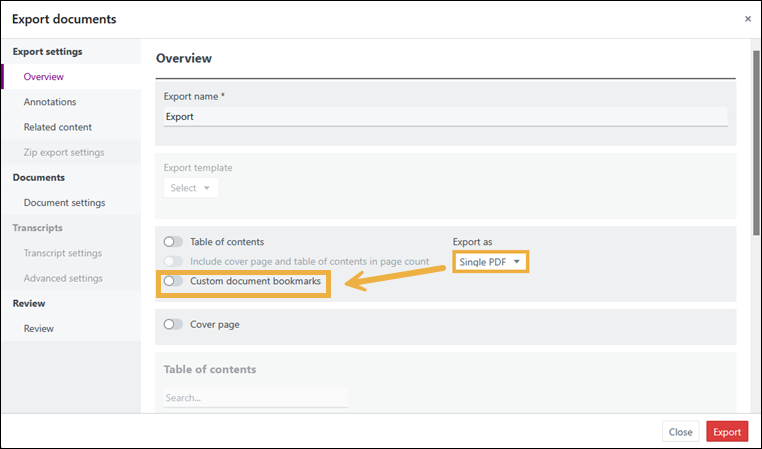
- Select the Custom document bookmarks option.
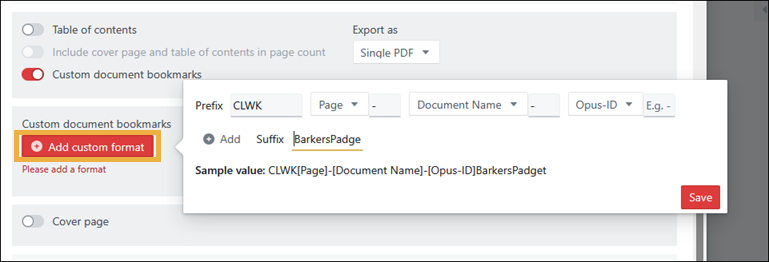
- Select Add custom format and configure the desired fields and delimiters.
Cover page: Optionally includes a cover page at the start of the export. Only available for single PDF format.
Cover page selector: Allows you to select a document within the project to use as the cover page. Only available if cover page is enabled.
Tip: For customisable TOCs on collections, only A4 size and cover pages without images are supported.
Table of contents field selector: Provides a filterable list of document metadata fields for inclusion in the TOC. Select one or more fields and click Add fields. Added fields can be removed using the X icon. Only available if table of contents is enabled.
Start table of contents on cover page: Enables the Position of TOC selector, allowing you to control where the TOC begins.
Position of TOC: (collection exports only) If both a cover page and TOC are included, this option controls where the TOC starts on the cover page:
- Immediately after cover page – TOC starts immediately after the cover page ends.
- After 75% of page – TOC starts in the lower quarter of the cover page.
- After 50% of page – TOC starts in the lower half of the cover page.
- After 25% of page – TOC starts in the lower three-quarters of the cover page.
Annotations
Annotations to include Controls whether annotations are included in the export:
- No annotations – No annotations are included, even if they exist on the selected documents.
- All annotations – All annotations present on the selected documents are included.
- Selected authors – Only annotations made by specific users or user groups are included.
Users and groups Available when Selected authors is selected. Allows you to specify which users or user groups' annotations should be included.
Include annotated pages only: When enabled, pages without annotated content are excluded from the export. Only available if annotations are enabled.
Annotation cards: When enabled, annotation cards are included alongside the exported documents. When disabled, documents are exported with annotation highlights only, without the associated cards. Only available if annotations are enabled.
Filter: Allows further filtering of which annotations to include, based on the fields available for each annotation type. Only available if annotations are enabled.
Related content
Include linked documents: When enabled, documents linked from the selected export documents are also included.
Include cards for links: When enabled, cards are included for each link to show details about the destination document.
Families to include: Includes documents that share a family with the selected export documents. One or more family types can be selected.
Location: Controls where related content appears in the export. For zip exports, related content is always placed in a related content subfolder. For PDF exports, related content can be placed in a subfolder or appended to the end of the exported PDF.
Zip export settings
Zip folder structure: Determines how the zip folder is structured:
- Single directory – All documents are placed in a single folder within the zip file.
- Folders – The folder structure from the platform is preserved within the zip file.
Natives converted to PDF: Controls whether the export includes original file types or converts all files to their platform PDF equivalents.
File naming: Defines the file naming convention for exported files in the zip folder.
Document settings
Document stamps: If using Stamps, no selection is required. For legacy stamps, select the stamps already applied to your documents that should be included in the export.
Anchor stamps to (legacy stamps only): Controls stamp positioning on landscape pages:
- Text – Stamps on landscape pages rotate in alignment with the document text.
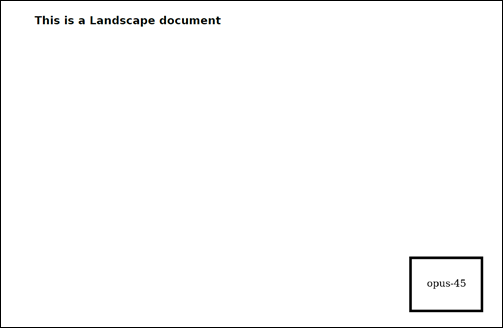
- Portrait page – Stamps on landscape pages align to portrait orientation (bottom-right corner). Use this setting to ensure stamps appear in the same position on all pages when exporting to a portrait bundle.
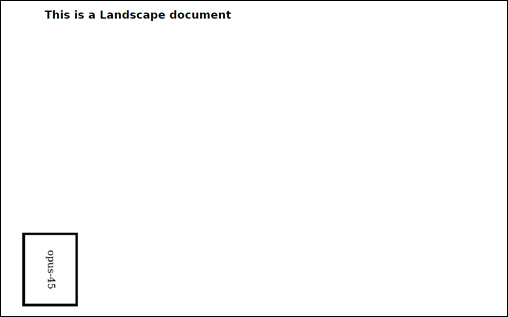
Page rotation: Rotates landscape pages in selected documents or a collection clockwise or counter-clockwise by 90 degrees:
- None – Landscape pages remain as-is and rotate when printed.
- Rotate all pages clockwise – The document is rotated so text reads from top-right to bottom-left in the exported PDF.
- Rotate all pages counter-clockwise – As above, but rotated in the opposite direction.
When stamps are anchored to the portrait page, their rotation behaviour depends on the page rotation setting:
- Rotate all pages clockwise – Stamps are rotated counter-clockwise.
- Rotate all pages counter-clockwise – Stamps are rotated clockwise.
When stamps are anchored to text, they rotate with the page and maintain their position relative to the content.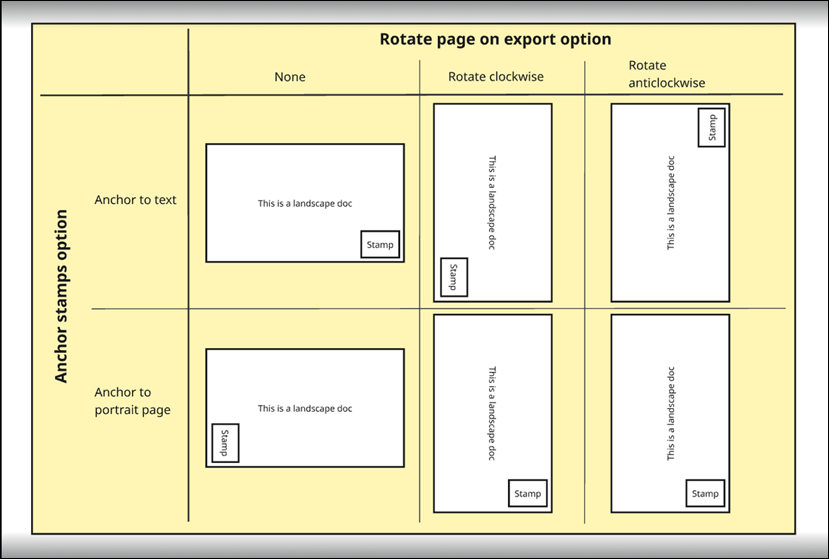
Transcript settings
Cover page: Controls whether a cover page is included with the exported transcript.
Word index: Controls whether the word index is included with the exported transcript.
Include time codes in export: Controls whether media time codes are included in the exported transcript.
Range: Allows you to export a specific range of pages from the transcript rather than the entire document.
Advanced settings
Layout: Choose from:
- Full page – Standard full-page layout.
- Condensed (2x2) – Four pages grouped on each exported page.
Print front and rear pages full size: When Condensed format is selected, this option exports the front and rear pages at full size.
Annotation brackets: Controls whether a bar appears alongside designations. If enabled, choose a position of Right or Left.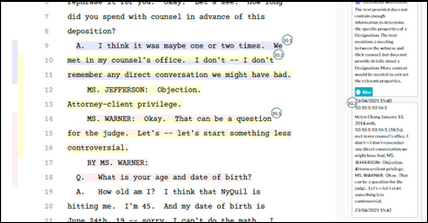
Include annotation summary: When enabled, a summary of all designations is included in the transcript, grouped by designation type.
Chronology: When enabled, designations from the Chronology worksheet are included in the transcript export.
Field selector: Selects the fields to export containing designations from the Chronology worksheet.
Header and footer: Allows additional content to be added to the transcript header and footer before export, such as a case name. Each of the Left, Centre, and Right positions can be configured from a menu of available field names. The Right footer position is pre-populated with the page number field by default, unless an export template with customised header and footer settings has been applied.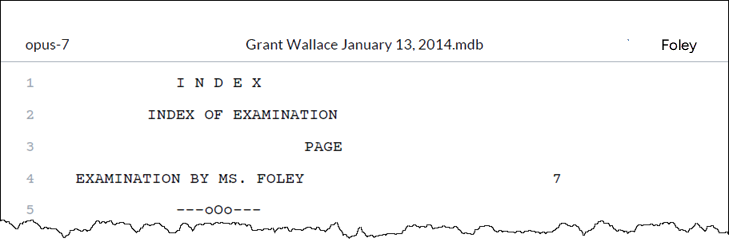
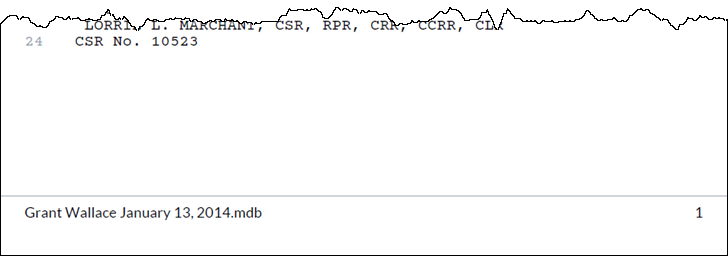
Note: Applying a custom header or footer slightly reduces the page size. Most printers will auto-scale to accommodate this.
Review
The Review tab displays a summary of all configured export settings before the export is triggered. Settings shown include export name, annotations, stamps, related content, export format, table of contents options, zip folder structure, file naming, and annotation style, among others.
Review all settings carefully before proceeding. If any setting needs to be changed, select the relevant tab from the left-hand panel to go back and adjust it.
Save export template: If you want to reuse the current export configuration in future, enter a name in the Template name field and click Save template. Saved templates can be selected from the Export template dropdown on the Overview tab in future exports, avoiding the need to reconfigure the same settings each time.
Once satisfied with the settings, click Export to trigger the export, or Close to exit without exporting.
Related links
Related documentation
Opus 2 has help information accessible within the application; click the question mark and then select Documentation in the upper-right area of the platform. You can also access the documentation at: Opus 2 Support.
How to contact us
To contact us about the documentation, or if you have any other questions or issues about Opus 2 solutions, contact Opus 2 Platform Support by emailing Opus 2 Platform Support.