
| Minimum Software Version | 8.18.10 |
| Solution(s) | Cases International ✓ Cases US ✓ Institutions ⨉ Counsel ✓ |
Explains how to create and manage procedural events in the Procedural Timetable worksheet, including table, timeline, and calendar views.
The Procedural Timetable worksheet centralises all important procedural events throughout the lifecycle of a case. Each event captures critical details such as dates, responsible parties, procedural phases, status, and supporting documents. In addition to the standard table layout, the worksheet offers Timeline and Calendar views to help users visualise case progress and upcoming deadlines.
Creating a procedural event
Step 1: Add a new procedural event
- Navigate to the Procedural Timetable worksheet.
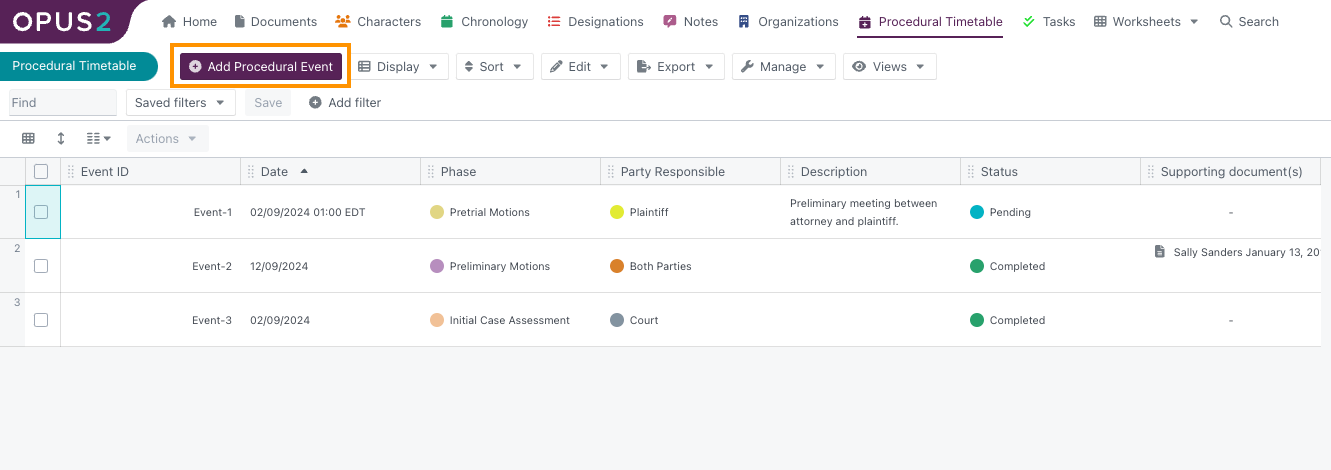
- Select the + Add Procedural Event button at the top left of the table.
Step 2: Complete the Add Procedural Event form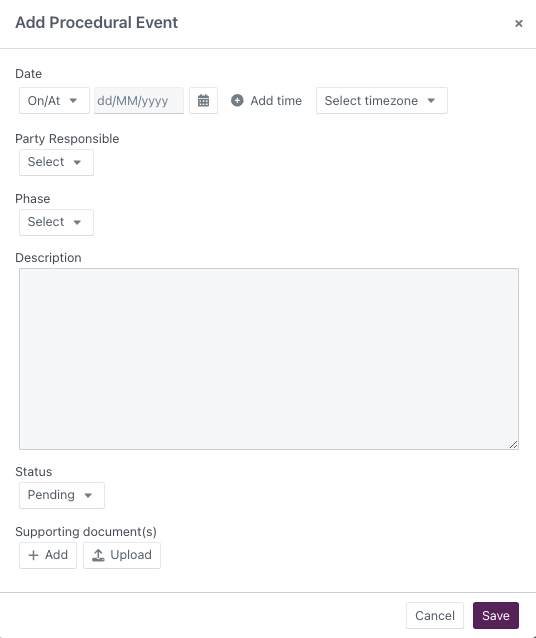
Fill in the relevant fields:
| Field | Description |
|---|---|
| Date | Defines the procedural event date. Supports time, time zone, date ranges, and incomplete dates. Options include On/At, Before, After, Between, and Starting at. |
| Party responsible | The party responsible for the event. Default options include Plaintiff, Defendant, Both Parties, and Court. Values can be customised by system administrators. |
| Phase | The procedural phase of the case. Default phases include Initial Case Assessment, Pleadings, Preliminary Motions, Discovery, Pretrial Motions, Pretrial Conference, Trial Preparation, Trial, and Judgment and Appeals. |
| Description | Additional details or notes related to the procedural event. |
| Status | Indicates whether the event is Pending or Complete. Status values can be customised by system administrators. |
| Supporting documents | Attach relevant documents associated with the procedural event. |
Step 3: Save the event
Select Save. The newly created procedural event appears in the Procedural Timetable table.
Example: Add an event titled Discovery Deadline with a status of Pending and link supporting discovery documents.
Viewing procedural events
Table view
By default, procedural events are displayed in a table format. To return to table view at any time, select Display > Table.
Timeline and calendar views
The Procedural Timetable worksheet also supports a Timeline display with date-based views.
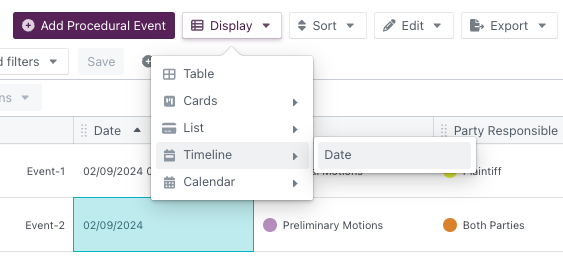
To switch to the timeline view:
- Select the Display dropdown.
- Select Timeline.
- Choose Date.
Once in the timeline view, select the Timeline Date dropdown to choose between: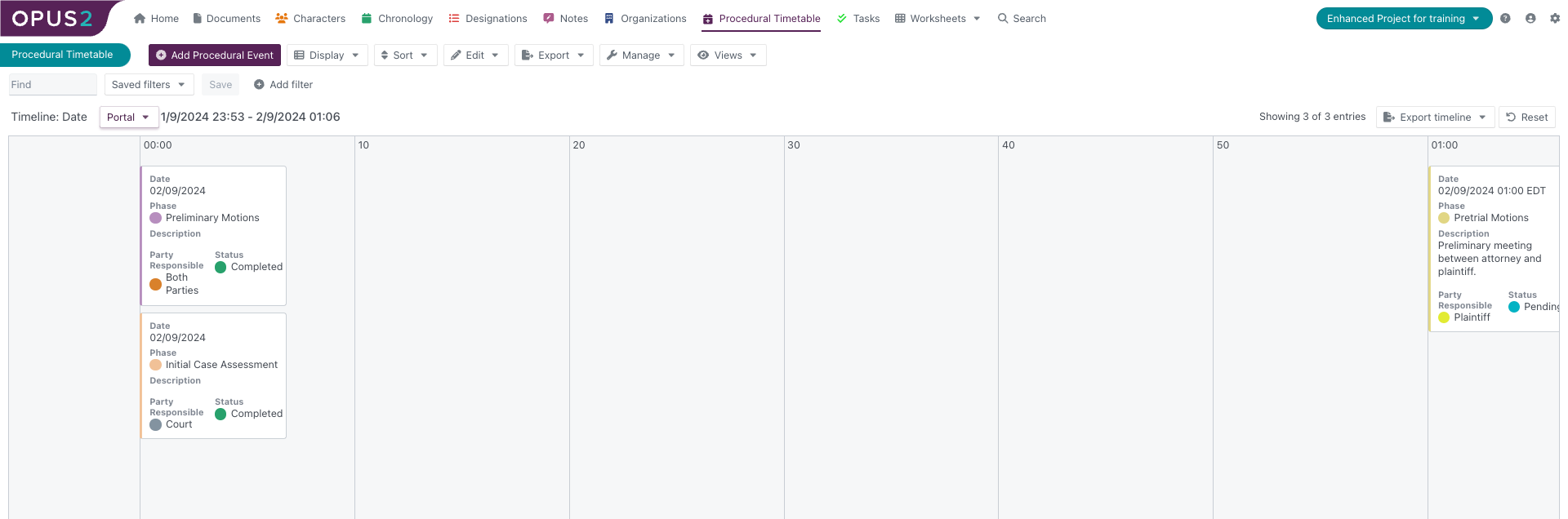
Timeline view: Displays a simplified representation of events over time, showing limited information for quick reference.
Portal view: Displays more detailed event information, suitable for comprehensive event review and sharing.
Related links
Related documentation
Opus 2 has help information accessible within the application; click the question mark and then select Documentation in the upper-right area of the platform. You can also access the documentation at: Opus 2 Support.
How to contact us
To contact us about the documentation, or if you have any other questions or issues about Opus 2 solutions, contact Opus 2 Platform Support by emailing Opus 2 Platform Support.