
| Minimum Software Version | 8.18.6 |
| Solution(s) | All |
This article outlines how to configure your Relativity Integration within a project. For information on security and APIs in use, please refer to our Overview Documentation.
Prerequisites
You require some additional information before setting up the integration, and you also require certain permissions, as follows:
- You require at least a Project Admin level role on Opus 2.
- You need the Client ID and Client Secret from Relativity or your Relativity Provider.
- The URL of your Relativity instance.
Setup
- Navigate to Project settings option in the main project menu.
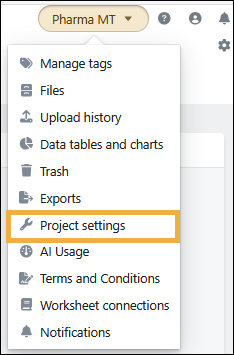
- Navigate to the Integrations menu tab.
- Select Add New Integration and then select Relativity from the drop-down menu.
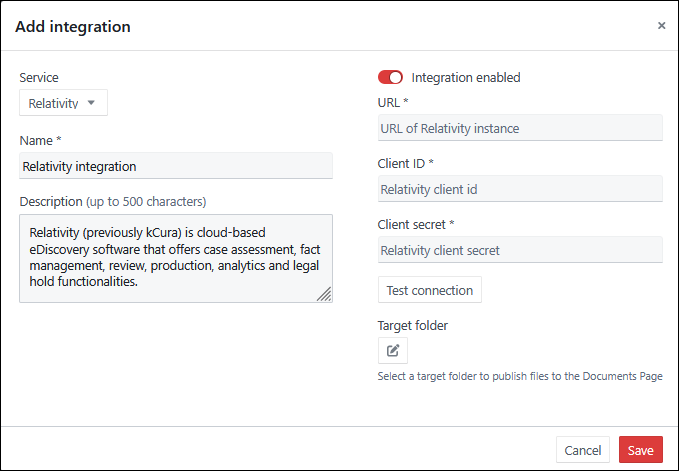
- Enter a Name, and optionally, a Description. These details are used to identify different connections if you have more than one.
- Enter the URL of the Relativity instance you want to connect to, for example: https://relativity.example.com/Relativity/
Note: Ensure you include the /Relativity/ at the end of the URL, as this is the API endpoint for Relativity connections.
Enter the Client ID and Client Secret to connect to your Relativity instance. The Client ID / Client Secret need to be generated on your Relativity Instance by an admin.
- Select Test Connection. You are looking for a "Connected" message to confirm all above details are correct.
Configuration
Once you have setup your integration as described above, there are some additional steps to be carried out to enable syncing.
If you hover over the Run button of a newly created integration, the button is unavailable and you are reminded of what needs to be selected before the integration can be run:
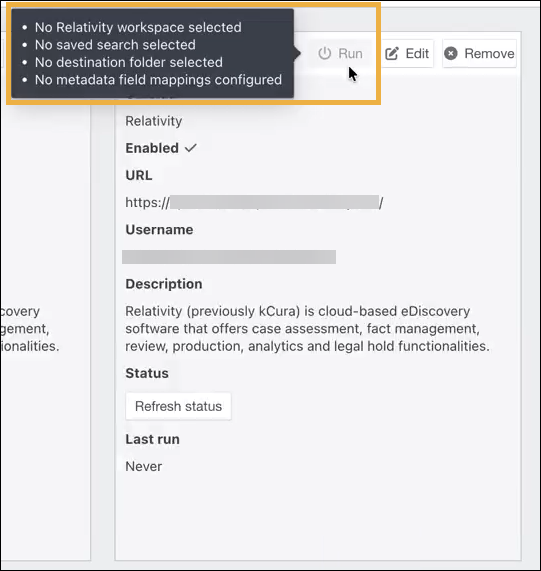
Options
On the Options tab, select the following to proceed:
- A Relativity workspace
- A saved search
Note: The Relativity User you are impersonating has the correct permissions to view all Workspaces / Saved Searches needed. The current limit for saved searches is 1000 - you need to keep your saved search count visible to this user under this limit to see the full scope of searches in the integration.
Metadata
The Metadata and Files tabs are not enabled until you have selected a workspace and a saved search.
On this tab, you can map Relativity Fields to Opus 2 Metadata fields.
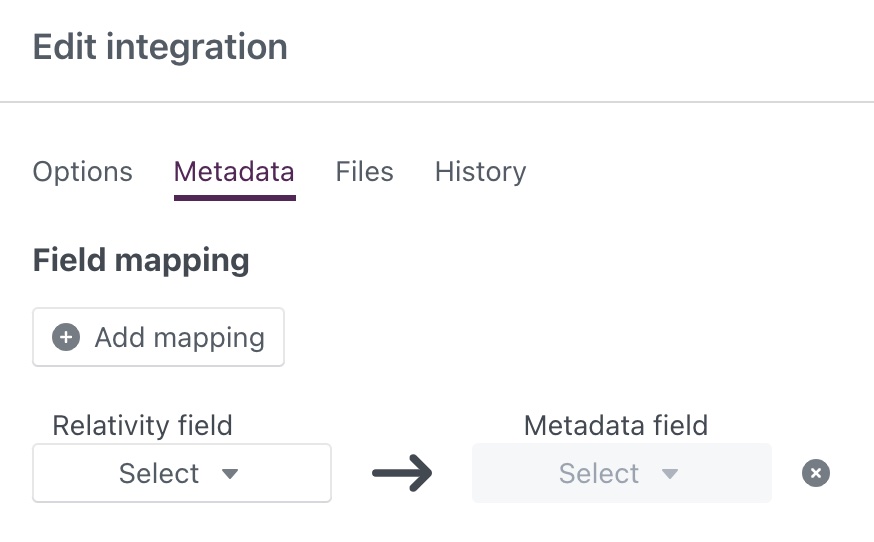
Select Add Mapping for each new field you wish to map. The field type is listed alongside each field to help you identify matching field types to map together.
Note: Field Types must be the same in order to carry out a mapping. For example, you cannot sync a Date field in Relativity to a Number Field in the Opus 2 Platform.
Files
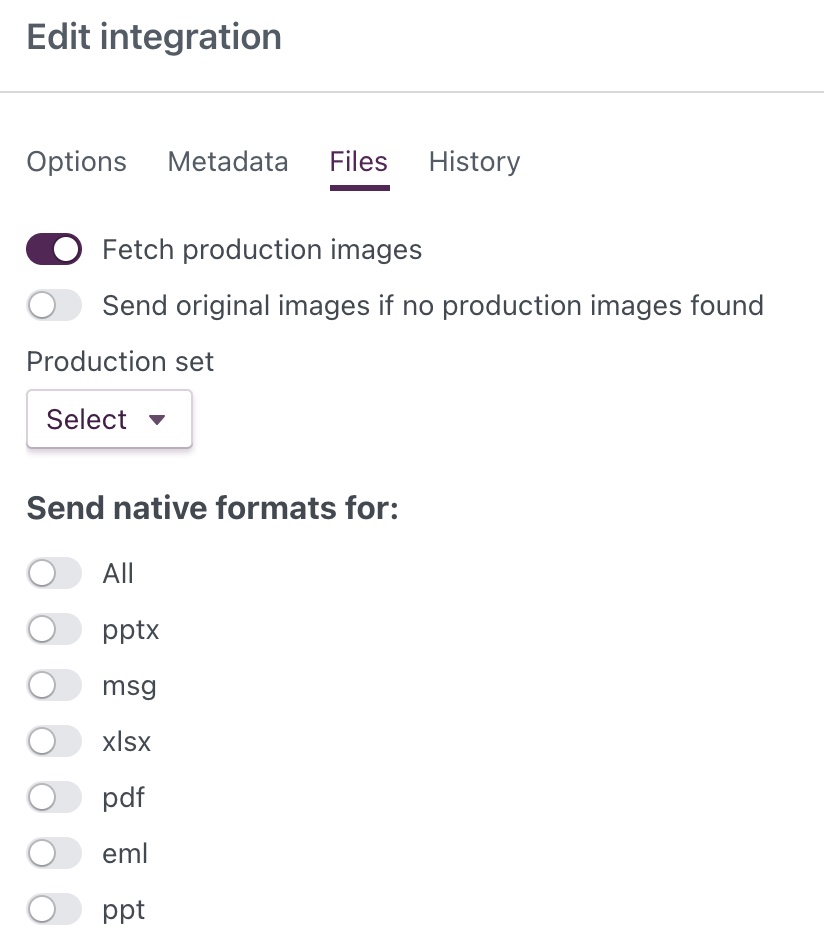
On this tab, you can choose a variety of options for what format you would like your data to be synced in.
The options are as follows:
- Fetch production images: If selected, choose a Production set.
- Send original images if no production images found: This sends the native PDF or TIFF if there are no Production sets.
- Send native formats for: This includes a list of formats that Relativity has reported to the integration as being available.
After the configuration is complete, select Save.
Running the IntegrationOn the next dialogue, hover over the Run button, which should now be enabled, and check that no messages appear.
Select Run. 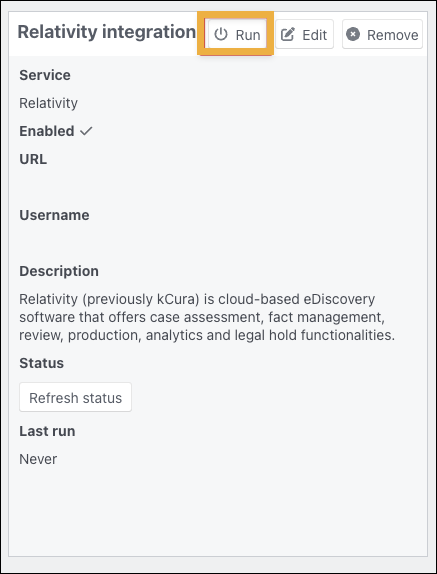
Issues and Troubleshooting
We do have performance limits when syncing Relativity documents and metadata, these can be found here. If you receive an error message when selecting Run, stop and contact platformsupport@opus2.com before selecting the button again so we can review the integration for you.